We use cookies. By continuing to use this site, you accept privacy policy

Decorative Concrete In Interior

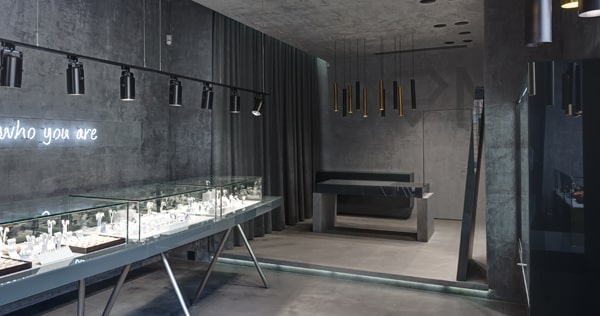
Concrete will probably never lose its prominence. If in the past it was unthinkable to decorate a room with concrete, today, on the contrary, it is in trend. Nowadays, no one is surprised to see a concrete floor, decorative concrete on the walls and ceiling. Moreover, it can be applied even to furniture facades. Today it is impossible to imagine a room in loft style or minimalism without it.
What is special about decorative concrete is that it is easy to work with and maintain. It is solid, durable and affordable at the same time. It has a number of characteristics that allow it to be used to design spaces for various purposes. Decorative concrete is quite stylish and meanwhile democratic.

What Is Decorative Concrete
Decorative concrete is most often represented in the interior with microcement or decorative plaster. It is also common to find natural concrete, processed by special methods and coated with transparent varnishes for additional usability. Decorative microcement concrete has a number of advantages over natural concrete. It practically does not create a load on buildings and furniture elements.
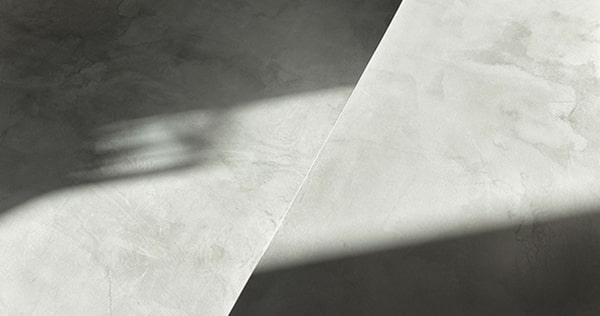
By adding mineral colorants to the composition of microcement, it can be dyed any color. And with the help of spatulas and stamps, an experienced craftsman can create any texture on the surface: formwork, wood, stone, tile, etc. The final coating of concrete plaster with several layers of varnish enhances its natural strength and hydrophobicity, making it even more decorative.
Depending on the additives used, concrete plasters are divided into mineral cement and polymer cement.
Depending on the size of the fraction of sand used, the mixtures are divided into microcement (denser and more uniform coating) and microconcrete (forms a looser and more textured surface).
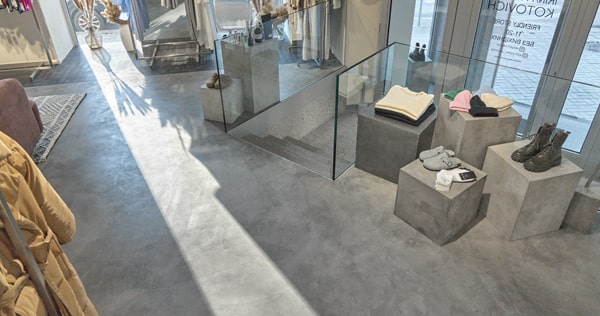
In terms of practicality, decorative concrete is not inferior to asphalt or paving slabs. It does not fade under sunlight, is resistant to thermal and mechanical stress. Thank you to its plasticity, it is resistant to deformation and abrasion. This allows the use of decorative concrete in rooms with increased human traffic.
It can be successfully used in public buildings and residential premises. The excellent thermal conductivity of decorative concrete and the fact that the final coating layer is only about 3 mm makes it well compatible with underfloor heating systems.
It's a great choice for a hallway, bathroom or kitchen. Decorative concrete is often used for arranging patios, garden paths, adjoining areas.
What interior styles can decorative concrete be used with?
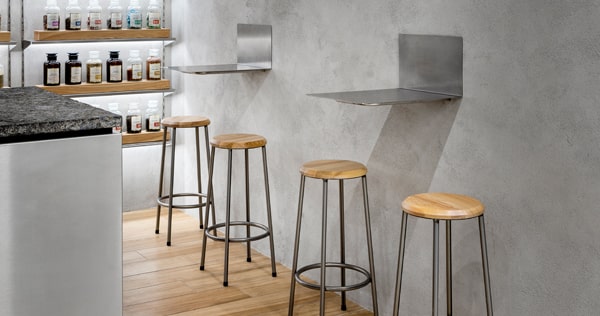
Covering the floor and walls with concrete is a must, especially for urban styles: high-tech, loft, minimalism and, of course, industrial. Here concrete emphasizes the ascetic and democratic atmosphere of the environment, which isn't overloaded with decorative details and focuses on texture and color. The chrome-plated metal of the furniture looks advantageous against the background of a gray, rough concrete wall. Decorative concrete, mixed with colors and covered with several layers of varnish perfectly complements the kitchen or bathroom in a minimalist style. It gives a sense of freedom, non-conditionality and space.
Being the most natural and plastic coating, decorative concrete is easily applied in some other styles. Its "modesty" can be balanced with wood or textiles selected in the desired color palette. For example, a “cold” concrete wall pairs well with a “warm” country-style wood floor, creating a harmoniously balanced atmosphere. Decorative concrete on the floor will also fit well into the laconic but cozy atmosphere of the Scandinavian style, gravitating towards a large amount of textiles.
Being a material that is not afraid of moisture, does not require maintenance and, most importantly, is not slippery, decorative concrete is indispensable when finishing a terrace, patio or balcony. For the same reasons, it is in demand in the construction of baths and pools.
Application features, pros and cons
Microcement has high adhesion and is not picky about the surface. It can be applied to plaster, drywall, rough concrete screed, leveling compound, directly to tiles, etc. The surface has to be clean and dry, pre-primed for better adhesion to the mixture.
There are so many options for using the material that it makes it possible to widely use it for a variety of construction and design purposes. The plasticity of decorative concrete allows you to create an original interior for every taste.
Advantages of decorative concrete:
it is used both on facades and in the interior;
it is strong and durable;
it has a huge decorative variety;
it withstands a large temperature range;
it can easily be restored;
it does not require special care in operation;
it is completely natural and safe for health;
it is affordable.
Decorative concrete, however, like any other material, has its pros and cons. Although there are far fewer cons than pros.
Most raw materials are mined and imported to Ukraine. Unfortunately, we still don't have a domestic manufacturer of a high-quality product.
The cost of microcement is comparable to that of an average budget tile, if you include the cost of tile adhesive, consumables and installation. Note that microcement is of great advantage when repairs need to be made quickly. This is because it can be applied directly to the old tile. This way, you avoid tedious and messy work like taking down and laying new tile.
Working with decorative concrete requires skills and specific equipment. And this work is best left to the professionals.
If you have chosen decorative concrete, the Tceh studio offers you installation services for any level of difficulty. We have extensive experience with this material in Lviv, Ivano-Frankivsk, Kyiv, Odessa, Kharkiv or any other city in Ukraine. We offer for sale a mixture of decorative concrete compositions from leading world manufacturers.