We use cookies. By continuing to use this site, you accept privacy policy

How to Prepare a Surface for Topciment Microcement Application

In
accordance with the technology, microcement is applied in layers no more than 1
mm thick. And the total thickness of the layers should not exceed 2-3 mm. This
thickness is not enough to mask significant surface defects. That is why
microcement should be applied on a previously leveled surface devoid of cracks,
voids and unevenness.
What kind of surfaces can Topciment
microcement be applied to?
Microcement
can cover almost any flat surface, both horizontal and vertical, indoors or
outdoors. Common base materials are cement screed, self-leveling mortar,
terrazzo, marble, tile, plasterboard or gypsum.
How to prepare
the surface properly
All
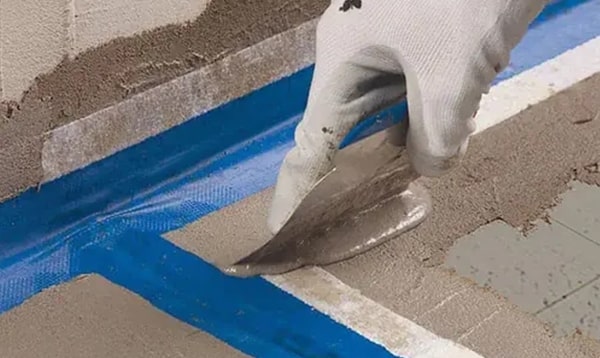
unstable layers must be removed from the surface. All voids, crevices, gaps and
deformational fissures should be filled. To do this, you can use, for example,
a mixture for filling cracks "Primer WB PU" and a reinforcing mesh
Uzin RR203.
All
metal or plastic beacons must be removed. Fill the holes from under them with a
special solution. All protruding elements, such as reinforcement, wire, etc.,
must also be removed.
If
you are going to apply microcement to a tile, thoroughly check its durability.
All shaky, unstable tiles should be removed, and the voids filled with a repair
compound.
The
base is leveled using specialized mixtures. Ready-made screed or leveling compound
can be used for this. Before applying microcement, the base must be allowed to
remain for at least 7 days, depending on the recommendation of the manufacturer
of the mixture used. It is advisable to use a beaconless leveling system.
Te
enhance the quality of the base in case of its insufficient strength, using a
mixture of Mapei Prosfas within the specifications declared by the
manufacturer.
The
finished base must be stable, dry, durable, have a density of at least 15 mPa
and be even. Permissible error of the plane is not more than 1 mm per 1 meter.
It must be cleaned of dust and grease, since any contamination reduces the
adhesion of microcement to the base.
Microcement cracking
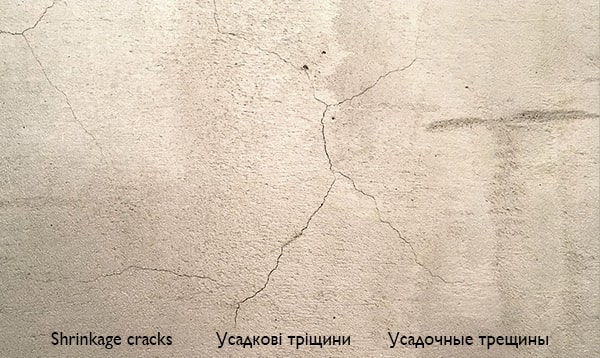
TM TOPCIMENT bi-component Microcement is both durable and resilient. In a joint with a reinforcing mesh, it suppresses most substrate shrinkage cracks.
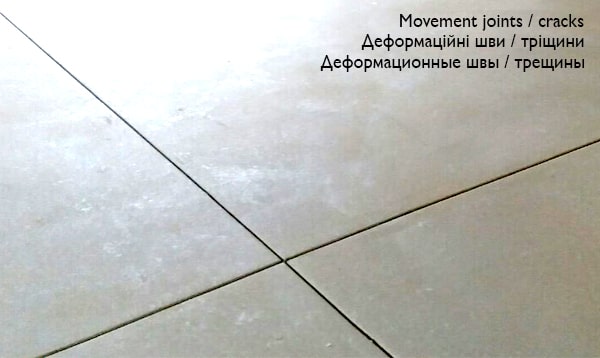
However, the possibility of the appearance of deformational (large) cracks in the substrate cannot be completely excluded. They can spread to the finish coat as well.
From our experience, cracking can be significantly eliminated with:
the use of expansion joints every 6 meters, in the areas of the boundary of the warm floor and doorways;
the use of masonry reinforcement mesh 50*50*3 mm when installing the screed;
the use of additional reinforcing glass mesh "Uzin RR203" in the areas where cracks are likely to appear.
The substrate
for microcement must be dry
Please
note that microcement cannot be applied to wet surfaces!
If
the humidity level exceeds 5%, the cause must first be identified and
eliminated. This is essential to ensure proper hardening of the coating.
The
fact is that the temperature, relative humidity of the air, the degree of
ventilation of the room where the work is carried out, affect the drying
process of the solutions and accelerate or slow down the hardening process.
Therefore,
during the course of work and over the next two weeks, the temperature of the
environment, mortar and substrate must remain within 10-30°C. The most optimal
working temperature is 20°C.
Heated floors
Microcement
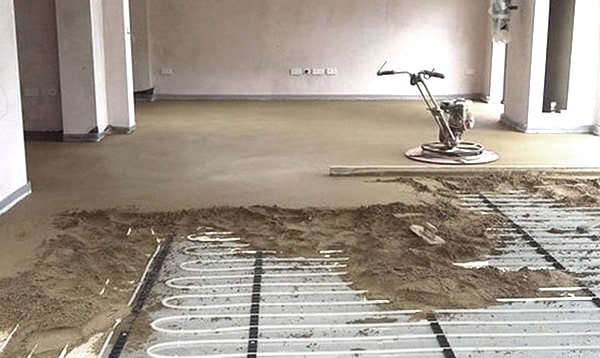
can be applied to heated floors, both water heated and electric. But, before
doing this, you need to warm up the heating system according to a certain
scheme (given below). This is necessary in order to avoid the transfer of
cracks from the base, which are formed due to temperature changes, to the microcement
layers.
To
prepare for the application of microcement over an electrical underfloor
heating system, a self-levelling cement-based leveling compound is used. For
example, Ultraplan Maxi Mapei is
recommended for underfloor heating with a hardness of 34 Newtons.
Microcement in
bathrooms
In
areas of high humidity (bathrooms, basements), it is first necessary to use Primapox®100 Barrier TM Topciment epoxy
moisture insulating primer. It is purposely designed to block rising moisture
and acts as a vapor barrier.
Indoors,
slopes must also be provided to avoid stagnant water. And lay the Mapei
waterproofing tape in the corners.
Moisture-resistant
MDF or shuttering plywood is used as sheet material in bathroom cabins and for
countertops.
Scheme of switching
on "Heated floor":
1.
Turn on the heating not earlier than 4 weeks after pouring the cement mortar
(screed).
2.
Keep the inlet water temperature at 25°C for 2-3 days. Then gradually increase
the water temperature to 45°C and maintain it for a few more days.
3.
Turn off the heating at least 48 hours before the start of microcement
application. The floor temperature must not exceed 18°C.
We
recommend using high-quality self-leveling cement mortars. The basis for
application must be holistic. Therefore, powder mortar bases should not be
used. Or they need to be further strengthened.
After
applying the microcement, at least 48 hours must elapse before the heating can
be switched on again. The temperature should be increased gradually (+5°C
daily).
Important!
The temperature at the beginning and at the end of the heating season must be
changed gradually. The relative humidity of the indoor air should not be too
low. The concentration of heat that can occur under carpets, rugs or under
furniture should also be avoided if the space between the bottom and the floor
is insufficient for proper ventilation.
Between
the floor and vertical surfaces, it is necessary to lay an expansion joint that
allows a change in the volume of material. Otherwise cracks may occur.
Only
if the surface meets all the listed requirements can we guarantee the strength
and durability of the final coating.
If
necessary, we can always evaluate your base, give recommendations on its
preparation, consult your specialists and check the correctness of the
preparation.
We
have compiled these recommendations based on our many years of experience. It
contains the basic rules and requirements and is advisory in nature. Each
specific surface must be evaluated individually. It is highly recommended that
this be done by a specialist.